
Table of Contents
- What Managed Print Services Mean for NHS Organisations
- Healthcare Managed Print Services: Why the NHS Needs Them
- Secure Printing for Healthcare: Protecting Patient Data
- NHS Printer Fleet Management: Consolidation and Control
- Managed Print Services Costs: Understanding the Investment
- Evaluating Providers: A Checklist for NHS Procurement Teams
- Implementing Managed Print Services Across Multiple Sites
- Frequently Asked Questions
Last Updated: 10 October 2026
What Managed Print Services Mean for NHS Organisations
Managed print services for NHS organisations represent a fundamental shift in how healthcare facilities handle their printing infrastructure. Rather than purchasing and maintaining printers independently, NHS trusts consolidate their fleet under a single managed contract that covers hardware, supplies, maintenance, and support. This approach transforms printing from a capital expense into a predictable operational cost.
The NHS faces mounting pressure to improve efficiency whilst controlling costs. Printing infrastructure often sits outside IT governance, creating fragmented environments where different departments operate incompatible devices, order supplies separately, and respond to breakdowns reactively. Managed print services for NHS settings eliminate these inefficiencies by centralising control, standardising equipment, and shifting responsibility for upkeep to a dedicated provider.
Crispin Associates helps public sector organisations optimise their office technology. The transition to managed print services typically reduces overall print spend, simplifies procurement compliance, and frees IT teams from reactive maintenance tasks.
The real benefit isn’t just cost savings, it’s predictability. Healthcare facilities can forecast their printing costs accurately, allocate budgets with confidence, and redirect IT resources toward clinical priorities rather than printer troubleshooting.
Healthcare Managed Print Services: Why the NHS Needs Them
Healthcare managed print services address specific challenges unique to NHS environments. Patient records, appointment letters, discharge summaries, and administrative documentation flow through printing systems constantly. A printer failure in a busy GP practice or hospital ward disrupts clinical workflows and delays patient care.
Managed print services for NHS trusts consolidate device management, reduce downtime through proactive maintenance, and ensure supplies are always available. Rather than waiting for IT to respond to a broken printer, healthcare facilities benefit from rapid response protocols and replacement devices when needed.
The environmental case is equally strong. Modern multifunction devices from managed print providers consume significantly less energy and paper than older equipment. Healthcare organisations increasingly face pressure to reduce their carbon footprint. Managed print services facilitate this transition by retiring inefficient devices and replacing them with equipment designed for sustainability.
Security considerations also favour centralised management. Patient data printed onto paper requires careful handling and secure disposal. Managed print services implement access controls, audit logging, and secure print release features that individual device ownership cannot match.
Secure Printing for Healthcare: Protecting Patient Data
Secure printing for healthcare is non-negotiable. NHS organisations handle sensitive patient information daily, medical histories, test results, prescription details, and personal identifiers that require protection under UK data protection law and NHS information governance standards.
Managed print services for NHS environments incorporate security features that standalone printers lack. Secure print release requires users to authenticate at the device before documents print, preventing sensitive materials from sitting in output trays. Audit logging tracks who printed what, when, and from which device, creating an accountability chain essential for compliance investigations.
Encryption of data in transit between computers and printers prevents interception of sensitive documents. Device-level security updates, delivered automatically by managed print providers, patch vulnerabilities before they become exploitable. This contrasts sharply with organisations that own printers outright and often delay or skip firmware updates.
Data sanitisation when devices reach end-of-life is another critical advantage. Managed print providers handle secure data destruction and device recycling, ensuring no patient information remains accessible on discarded hardware.
Organisations that manage printers independently often overlook security updates and data sanitisation, creating unintended data exposure risks. A single unpatched device can become an entry point for unauthorised access.
NHS Printer Fleet Management: Consolidation and Control
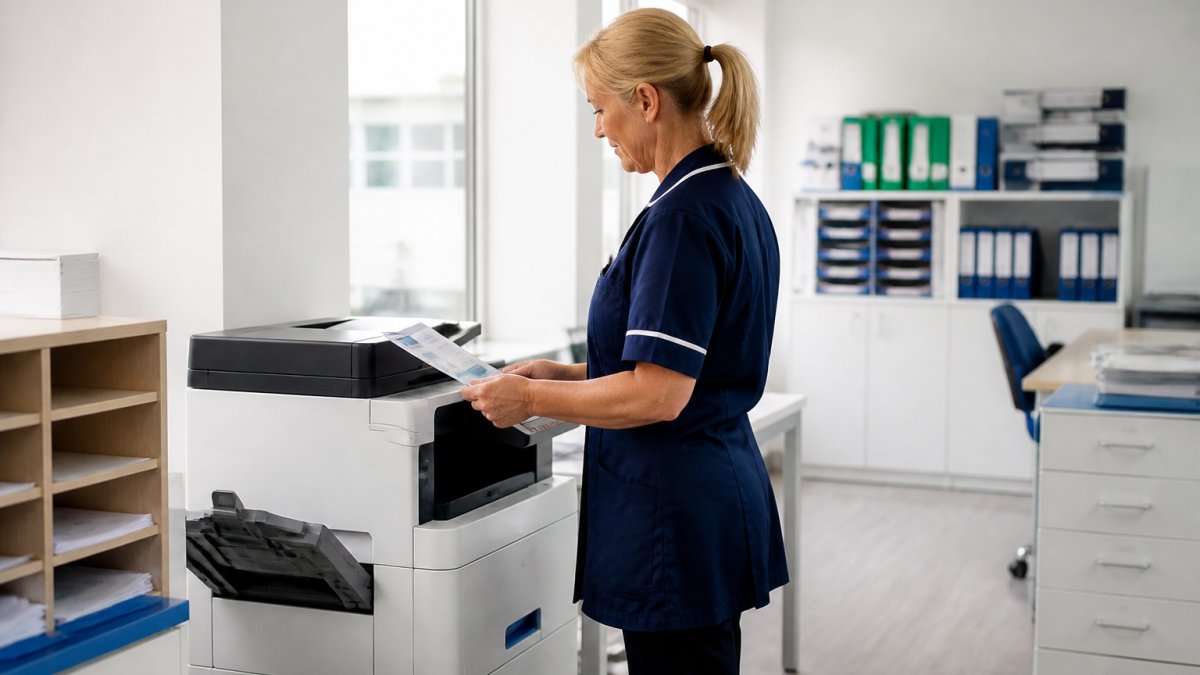
Printer fleet management across multiple NHS sites becomes exponentially more complex as organisations grow. A trust operating 15 GP practices, two community clinics, and a hospital might have 40-60 devices from different manufacturers, purchased at different times, running different firmware versions, and supported by different vendors.
Managed print services for NHS organisations consolidate this chaos. A single provider standardises on compatible equipment, delivers supplies to all locations, and maintains every device under one service agreement. Fleet visibility improves dramatically, administrators can see real-time usage data, identify underutilised devices, and right-size the fleet accordingly.
Consolidation also simplifies procurement. Rather than individual departments negotiating separate contracts, the NHS trust issues one managed print services agreement that covers all locations. This centralised approach improves compliance with public sector procurement standards and reduces administrative burden on procurement teams.
Device placement becomes strategic rather than reactive. Managed print providers analyse workflow patterns and recommend optimal device locations, reducing unnecessary printing and consolidating functions where possible.
Managed Print Services Costs: Understanding the Investment
Managed print services for NHS organisations typically operate on a per-page pricing model, where the NHS pays a fixed cost for each page printed. This shifts printing from a capital expense (buying devices) to an operational expense (paying per output).
Understanding the investment requires comparing total cost of ownership. Traditional ownership includes device purchase, supplies, maintenance contracts, IT labour for troubleshooting, and eventual replacement. Managed print services bundle these into a single monthly charge.
The financial case depends on current spending. Organisations with high print volumes, ageing equipment requiring frequent repairs, or fragmented supply chains typically see the strongest savings. Those already operating efficient, modern fleets may see modest improvements.
Cost visibility improves significantly. Rather than discovering unexpected repair bills or discovering that one department spent twice as much on supplies as another, managed print services provide transparent reporting. Monthly invoices reflect actual usage, and usage analytics help identify opportunities to reduce printing further.
The investment justifies itself when organisations currently spend heavily on printer maintenance, supplies, and IT labour. Request a cost analysis from potential providers comparing your current spend against proposed managed print services pricing.
Evaluating Providers: A Checklist for NHS Procurement Teams
Selecting a managed print services provider requires careful evaluation against NHS-specific requirements. Procurement teams should verify that potential providers understand healthcare environments and can meet compliance obligations.
Key evaluation criteria:
- NHS compliance experience: Has the provider worked with NHS trusts, GP practices, or other healthcare organisations? Can they reference similar implementations?
- Security certification: Does the provider hold relevant certifications (ISO 27001 for information security, or equivalent)?
- Support responsiveness: What are response times for device failures? Is 24/7 support available?
- Supply chain reliability: Can the provider guarantee consumables availability across all locations?
- Data handling practices: How does the provider manage data sanitisation, secure destruction, and audit trails?
- Environmental credentials: What sustainability commitments does the provider make?
- Contract flexibility: Can the contract accommodate growth, site closures, or changing device requirements?
- Reporting capabilities: What analytics and usage data does the provider supply?
Crispin Associates helps NHS organisations evaluate managed print services providers against these criteria. Our experience across education and public sector clients means we understand the specific pressures NHS procurement teams face.
Implementing Managed Print Services Across Multiple Sites
Implementation across multiple NHS sites requires careful planning. A phased rollout reduces disruption and allows teams to learn from early deployments before scaling.
Start with a pilot site, typically a single GP practice or department. This allows staff to familiarise themselves with new devices and workflows. Gather feedback on device placement, consumables delivery, and support responsiveness. Use this feedback to refine the implementation plan for remaining sites.
Communication with clinical and administrative staff is essential. Printing interruptions affect patient workflows. Staff need to understand why devices are changing, how to use new equipment, and how to request support. Training should be brief, practical, and available at the point of use.
Device decommissioning requires secure data handling. Work with your managed print provider to ensure all data is sanitised from existing devices before they’re removed. Maintain an inventory of device locations and usage patterns to inform placement decisions for replacement equipment.
The shift toward managed print services for NHS organisations reflects a broader recognition that healthcare IT should focus on clinical priorities rather than device maintenance. Consolidating printing infrastructure under professional management reduces costs, improves security, and frees IT teams to concentrate on systems that directly support patient care.
Crispin Associates specialises in helping NHS trusts and healthcare organisations implement managed print services that deliver efficient communication, secure data handling, and comprehensive manufacturer support. Our team understands the compliance requirements, security standards, and operational pressures unique to healthcare environments. Contact us to discuss how managed print services can optimise your organisation’s printing infrastructure and reduce operational complexity.
Frequently Asked Questions
What exactly does managed print services for NHS organisations include?
Managed print services for NHS trusts cover printer and copier supply, maintenance, consumables management, technical support, and fleet optimisation. Providers monitor device usage, handle repairs proactively, manage toner and paper supplies, and offer security features tailored to healthcare compliance. The service removes the burden of equipment management from NHS IT teams, allowing them to focus on clinical systems instead.
How does secure printing for healthcare protect patient information?
Secure printing for healthcare includes encrypted data transmission, user authentication at devices, and automatic document deletion after collection. These features prevent sensitive patient records from sitting unattended in output trays or being accessed by unauthorised staff. Healthcare managed print services providers implement controls aligned with GDPR and NHS data protection standards, ensuring printed documents remain confidential throughout their lifecycle.
What factors influence managed print services costs for NHS trusts?
Managed print services costs depend on fleet size, monthly print volume, device types, support response times, and geographic spread across multiple sites. NHS organisations typically see cost savings through reduced consumables waste, fewer device breakdowns, and optimised fleet size. Pricing models vary, some providers charge per page, others per device monthly. Request a detailed cost comparison against current spending to understand the investment required and potential return.
How long does it take to implement managed print services across an NHS trust?
Implementation timescales depend on the number of sites and devices involved. Smaller implementations across one or two locations may take 4-8 weeks, while trust-wide rollouts across 10+ sites typically require 3-6 months. Providers should conduct an initial audit, design the optimal fleet configuration, coordinate device installation, train staff, and establish support processes. Experienced providers minimise disruption by phasing implementation site by site and providing comprehensive staff training.